
Why We Use ASL-Based Signs (And What’s Next for Baby Sign Bibs!)
Unlock the secret to earlier communication with your little one! 🤟 Discover why our signature bib sets use the global... Read more


Unlock the secret to earlier communication with your little one! 🤟 Discover why our signature bib sets use the global... Read more

Baby sign language is the use of manual signing allowing babies, infants and toddlers to communicate emotions, desires, and objects prior to spoken language development.
With guidance and encouragement, signing develops from a natural stage in infant development known as gesture.
You can start using baby signs as early as you like or when you notice your baby showing interest in communication, such as reaching for objects, making sounds, or imitating gestures.
Infants typically start to become more aware of their surroundings and develop the motor skills needed to make basic gestures and signs themselves around 6 to 9 months of age, so this is when most parents/carers begin introducing baby signs as we did with our children.
It is important to follow your infant’s lead and pace when introducing signs and not feel pressured to start using baby signs at a specific age. Using baby signs should be a positive and enjoyable experience between you and your baby.
Even if your baby doesn’t quite pay attention to you in the beginning, it is a great way for you to get into the habit of using them in your daily routine.
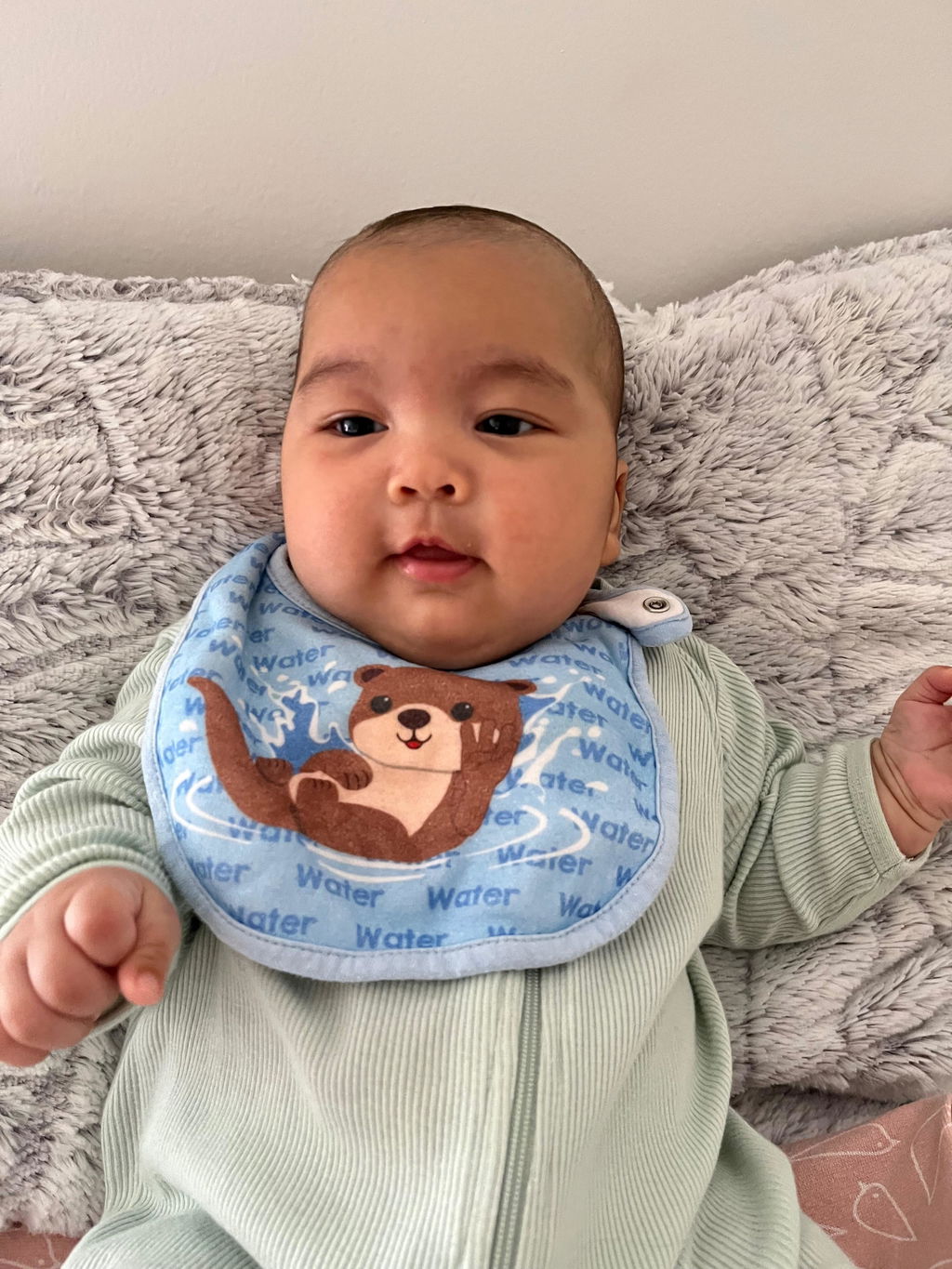
The easiest signs to introduce are those that you use in your daily routines. That is why we have designed our mealtime Baby Sign Bib™ range to introduce the signs of ‘Eat’, ‘More’, ‘Water’, and ‘All Done’.
We found that by incorporating and using these four baby signs into our daily mealtime routine, our children associated the signs and their meaning more quickly.
'More' is our recommendation for the first baby sign to start incorporating into your daily routine as it can be used for a number of different activities such as at mealtime and playtimes.
Consistency is key when using baby signs as the more you incorporate the use of them into your daily routine, the more likely it is that your baby will start to imitate and respond back to you using a variation of the sign.
For example, we used the baby sign for 'More' with our son from 6 months of age at every meal and play time. At 8 months he began clapping his hands as an indication he wanted more.
It is important to note that your baby will use different variations of the Baby Signs you are teaching them to start with as they begin to learn how to control their motor functions.
Linda P. Acredolo and Susan W. Goodwyn, pioneers in the field of infant communication, conducted extensive research on baby sign language, culminating in their influential book, Baby Signs: How to Talk with Your Baby Before Your Baby Can Talk.
Their studies demonstrated that infants as young as nine months could use simple signs to communicate needs and observations, potentially enhancing early language development and strengthening parent-child bonds.
One notable study by Goodwyn, Acredolo, and Brown (2000) examined the impact of symbolic gesturing on early language development. The researchers found that infants who were encouraged to use symbolic gestures exhibited advanced language skills compared to those who did not use such gestures. This study highlighted the potential benefits of incorporating baby sign language into early childhood communication practices.
These studies, among others, provide empirical support for the benefits of baby sign language as detailed in Acredolo and Goodwyn's book. Their work has been instrumental in promoting the use of symbolic gestures to facilitate early communication between parents and infants.
Not exactly! Baby Signs and Adult Sign Language (like American Sign Language - ASL, British Sign Language - BSL, etc.) are different in their purpose and structure.
Baby Sign Language:
Adult Sign Language (like ASL):
No. Research has shown that using baby signs does not delay speech development.
Why this is the case:
Baby Sign Bibs uses gestures commonly taught in Baby Sign Language, which is based on simplified American Sign Language (ASL).
This is the system used globally in most baby‑signing programs because the signs are easy for babies to copy and are widely recognised by parents.
We absolutely respect and value Auslan, and we’re currently exploring an Australian‑specific range for families who prefer Auslan‑aligned signs. In the meantime, our current bibs are designed to support early communication between parents and babies - regardless of which sign language they go on to learn later.